
Shenanigans

If you’d prefer to listen to this week’s newsletter, you can find The Fig podcast here.
Dear Friends,
Nora is very excited about our upcoming move to India. Her new school has a pool. The embassy has a pool. These are two places that exist in Kyrgyzstan but do not have pools. Did you know that Nora likes pools? She likes them a lot.
Last Friday, I took Nora to the local hot springs because school was closed for parent-teacher conferences. She shimmied bright yellow water wings onto her arms and floated around the bath-water warm pools in absolute bliss.
“What if,” she said, “the Embassy pool had a water slide that connected to the school pool, and then I could go down it to get to school every day?”
“Wouldn’t your backpack get wet?” I asked.
“You could order me a waterproof backpack from Amazon,” she said.
I am not in the habit of crushing imagination. My hopes are, however, more limited: there is embassy housing that is walkable to the school she will attend. Hoping for that housing assignment is probably as far-fetched as the water slide configuration, but a girl can dream.
“I am tired of snow. I want to be in India where there will be no snow ever,” Nora tells me the next week as we walk to the bus stop in the flurries.
“India will be great,” I say. “But we are here right now. We still have lots of fun things to do with our friends in Bishkek.”
Besides, I don’t say, I have loved living in a place with four seasons. I am not looking forward to the return of being sweaty. I will miss my knitwear.
I do get where she’s coming from, though. It’s that point in winter where multiple friends have confessed to me that all they want to do is nap all day, and they’re wondering what is wrong. (Nothing. I think humans are meant to seasonally power-down more than we do.) It’s that time of winter when we’ve had a few fake-out spring days to taunt our brains into thinking better times are coming, but now it’s flurrying again, and everything feels soggy and endless.
We’re far enough past the spark of New Year’s enthusiasm that whatever resolutions or reinvigorated commitments we’ve made to ourselves are lagging, and we’re feeling guilty about not being more engaged.
February be like that.
My energy is down, but the shenanigans keep coming. And it’s not like moving to India is going to reduce the number of shenanigans in my life.
Wherever you go, there you are, and all that.
This is not to say that America doesn’t have shenanigans. If anything, America is mostly shenanigans these days. But there are some things in the States that are easy compared to their overseas counterparts.
For instance, ordering food for delivery.
In Virginia, if I want to order dinner, I fire up the good old DoorDash app. I find the restaurant I want, read through the menu (in English), add the items to my cart, and check out. Soon, the DoorDash driver rings my doorbell and hands me the bag from the restaurant. Dinner is served!
In Bishkek, there is a DoorDash-like app, Glovo, that will deliver food. But I don’t use it because, for some reason, my credit card doesn’t work in the app. I’ve tried the cash on delivery option, but it only lets you place orders up to 2000 som (about $20).
Fortunately, my favorite Indian restaurant accepts orders via WhatsApp. It’s easy! Kind of.
First I consult the online menu, then text the restaurant to tell them what I want and my address. They send me the total, which I need to pay through OBank, a local digital wallet app.
I realize I don’t have any money on my OBank. To top it up, I need to feed some cash into an OBank machine. I grab some money and hop on my bike, then zip down to the machine down the street, the machine that has been there for the past two years.
It is gone. So is the coffeeshop that likely contracted its existence.
No problem. Azbuka, the grocery store across the street, fondly known as “The Bu,” has some kind of bank machine. It’s not OBank, but MBank. MBank machines will let you top up your OBank wallet, but they charge a small fee. Also the machine doesn’t have an English option, so I have to take a photo with Google translate to make sure I’m selecting the right screen options.
Then I send money to the Indian restaurant through OBank and ride back home.
The restaurant sends me a link to the courier app that will deliver my food, but that app only works on my Kyrgyz phone, which is dead. I plug in the phone and hope that the courier app works this time. Last time, it glitched, so I had no way of knowing if the courier was getting closer.
This is important, because the courier can’t just drive up to my house. Our street is behind a locked security gate, which can’t be opened remotely. So anytime I need to meet anyone in a vehicle, I have to walk all the way down to the main road.
And if I’m not there when the courier appears, the worst will happen: he will call me and start asking me questions in Russian. Which I do not speak.
Fortunately, the courier app is working. I am ready when he arrives. I pay the courier (cash works for this) and take my bag-o-butter-chicken.
This is what I mean by shenanigans. Like, it’s fine, but literally everything takes twelve more steps to accomplish than it would in the states.
When you’re living overseas, you come to define your victories differently. You really savor the little wins: the obscure household item found, the small conversation in a foreign language. The palak paneer.
But if exhaustion hits and you’re totally over the snow, and you just want to be where the pools are, it makes sense. Even six-year-olds are not immune to the shenanigans. Sometimes your pack-lunch is subpar because the cereal your mom ordered is taking six weeks to arrive. Or the fish sticks you were going to eat for dinner went bad in a power outage, so you have to have scrambled eggs. You know. It’s death by a thousand snacks.
This week, Xleb, the little bakery kiosk in my neighborhood, closed down. No warning, no real explanation. Just a shuttered roller blind, and later, an Instagram post sharing that the location was closed, and to look for their other location in the 3rd microdistrict.
“Time to leave,” Charlotte texted the group chat. What’s the point of Bishkek without Xleb? The best pistachio croissants in town. Ciabatta to compliment any dinner. It was the spot we all visited when life got too overwhelming and we needed to bring something for the potluck or the school holiday party.
“I NEED ANSWERS,” my friend Jess texted, sending me Xleb’s Instagram post. But we’ll never know why they closed. Maybe the business wasn’t doing well enough; maybe the owner wanted to downsize. Or maybe they ran afoul of someone. A popular shop in the bazaar closed earlier this year under the guise of “importing illegal Russian goods,” but everyone figured someone just wanted them to pay more to operate in such a prime location.
It’s hard not to take the shenanigans personally. The kids ding-dong ditching our house late at night, waking Nora up. Landlords raising the rent on our government-leased houses, even though they signed contracts saying they wouldn’t. Road construction closing off the driveway entrance to the embassy.
This is why our overseas tours are limited to 2-3 year stints. You either go full cynic, or you go native, and neither of those is conducive to the work of diplomacy. Xleb is closed. Time to leave.
As our tour here comes to an end, I realize I’m only going to be a US government employee for three more months. In India, I’m going to try to expand my home-based businesses: teach more music classes, pick up more freelance graphic design clients, do more writing on this platform. More felting. The idea of structuring my own time is both thrilling and intimidating. Though I suppose India doesn’t have cold winter, so maybe the urge to nap all day won’t emerge.
The draw of the embassy job is magnetic, too—the pull of routines, of somewhere to go each day, and of knowing who’s who and what’s what. I can’t say for sure I won’t get suckered into applying for something, should a job in the CLO open up. I have realized during this tour, as Nora has begun full-time school, that I love to work, and I love this particular work most of all.
But I’m hoping I can make self-employment a success, just to see if I can. The certainty of being able to stand on my own through all the physical moves would be nice. Knowing that wherever we went, I would already be set—not quite so doomed to the scrambling life of the “trailing spouse.”
It’s the illusion of safety, of security, I know. It’s human nature. We can’t stop expending energy in the hopes we’ll get some calm, a chance to rest. And I’m no stranger to the real truth of side hustles—when you’re working for yourself, you’re always working.
Capitalism, it seems, is the ultimate shenanigan.
But so it goes. You gotta eat (though the bakery closing makes it harder). You gotta buy your kid a waterproof backpack from Amazon for her imaginary waterslide school commute.
I’m grateful to all of you for reading and subscribing. And I look forward to bringing you new, fresh shenanigans from India and beyond. Thanks for being here.
Stay out of trouble, stay in touch,
Dot
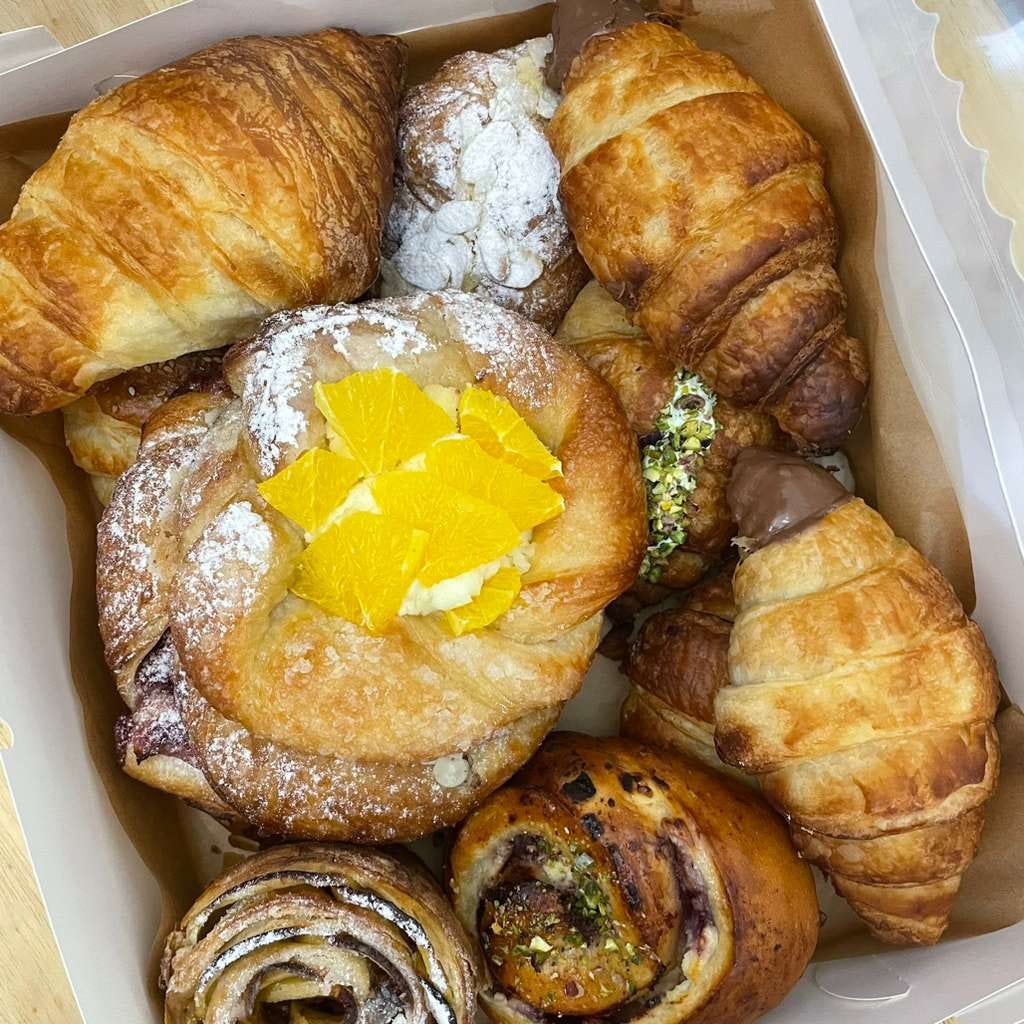
Good while it lasted.
Follow Along on Instagram

DISCLAIMER: The views expressed in this newsletter are my own, and do not necessarily reflect those of the US Department of State or the US Government.
If you can make it work (which sometimes takes quite a while), freelance life is very worth it, imo. Very excited to see what felting designs all the colors of India will inspire!
I’m so excited for your next chapter! And Indian bakeries(?)!