
It's Cool
An Essay Otherwise Known as "Shellington's Right Foot"

If you’d prefer to listen to this week’s newsletter, you can find The Fig podcast here.
Dear Friends,
On the road to Lake Issyk Kul, Bishkek’s city buildings give way to shacks made from shipping containers. The shacks give way to fields and farmland, and then to rocky, treeless mountains. It’s rhubarb season, and women stand on the side of the road and wave it at us as we drive by, beckoning us to stop. After the mountain passes, there are the lake towns. Balykchy, Tamchy, Chok Tal, Cholpon-Ata, each a strip with a pool float shop, a samsa stand, a shashlik restaurant, and somewhere to change a tire.
We are in the time of “last times.” In six weeks, we will have packed out our house and returned for a quick summer in America. Three months from today, Nora will start her new school in New Delhi. Jake will begin his new job at the embassy’s American Center. I will look around and try to figure out what my life is going to be next.
The Kyrgyz government and Nora’s school are closed for the first ten days of May. It’s too close to being gone forever to leave the country, so we book three nights at one of the resorts on Lake Issyk-Kul with our friends Sonja and Alex and their son Noah, who is nine.
Nora has recently decided that she won’t die if she puts her face in the water, so we’ve chosen a resort that advertises multiple heated pools, a spa, lake access, kids’ entertainment, and a wide array of restaurants.
I am looking forward to having lakeside cocktails with Sonja while our kids dig in the sand. I have packed a few felting projects I’d like to complete before a sale I’m having in a few weeks. I’m halfway through Lena Dunham’s new memoir, which I’d like to finish while watching Nora splash in the children’s pool. I’m hoping the spa offers pedicures and maybe even has a hot tub.
These seem like normal vacation hopes and dreams. But no—this is Kyrgyzstan.
Kyrgyzstan can be like when you’re playing a video game and your avatar wanders too close to the edge of the playable map.
Things are just a little less animated—a little more glitchy. There’s a sense that things are almost working, but the infrastructure is just a little off. Central Asia is far, far away from most everywhere else.
We check into the main resort hotel. Tilek, the employee managing the reception desk, gives us a sprawling map of the resort. He circles the pool and the main restaurant and the hours for each. The pool is open from 9AM. Meals are at 8:30AM, 1PM, and 7PM. The Kyrgyz people, including the children, whom Nora often refers to as “sleepover kids who never go to bed,” operate more nocturnally than Americans-with-kids. This meal schedule doesn’t surprise me, but both Nora and Noah are early risers. We will need coffee if we are to manage them until an 8:30AM breakfast. Hell, we will need coffee to make it through the rest of the afternoon.
Tilek invites us to join him in the resort golf cart, where he drives us to the main restaurant.
Inside, the disgruntled restaurant manager demands our meal cards. She leads us to a table at the very back of the restaurant and tells us this is where we will sit for the duration of our stay. She glares at Nora and Noah, who are discussing whether there might be any sting rays in Lake Issyk-Kul.
They are not the only children in the restaurant, nor are they the worst behaved. Some of the local kids are wrapping themselves in the fringe curtains separating the restaurant from the bathrooms. But what do we know? Something about us is offensive.
We go get food. There is mysterious mayonnaise salad, chicken legs, bulgur, noodles, and borscht.
“I thought you said it would be a buffet,” Noah accuses Sonja.
“It is,” she says.
“But on a buffet, there’s lots of choices,” Noah says.
“He’s not wrong,” I snort.
After lunch, the children want to go straight to the pool, but we convince them to explore the resort with us first.
“I read that there’s a sushi restaurant somewhere around here,” I say.
“And we MUST figure out the coffee scene,” says Sonja.
It’s a huge resort. It’s probably a fifteen-minute walk from the restaurant down to the lake. On our way, we pass an ice cream shack, which is closed.
“Maybe it’ll be open tonight,” we promise the kids.
Then we pass a franchise of a Bishkek Turkish restaurant—one of Sonja’s favorites. It, too, is closed. So is the bakery café, the shashlik restaurant, the CapyBARa beachside bar, the Hi-Tea bubble tea café, the tiki bar, and the seafood restaurant.
These establishments aren’t just closed—they’re closed closed. There are no bottles behind the bar. No tables on the floor. The stools and chairs are stacked in mountains blocking the doorways. One restaurant has a health department notice on the door. The seafood restaurant is so closed it looks like the whole place has been raptured—there are half tipped-over decorations broken on the ground and trash and papers blown about.
The only signs of life are near the sushi restaurant, which has a giant dragon on the roof.
“DAGRON restaurant better be open,” I say.
“DAGRON restaurant better have coffee,” says Sonja.
“What is DAGRON?” asks Noah, and I explain to him the joke from Homestar Runner, a time before he was born. A time before memes themselves, and before I had ever heard of Kyrgyzstan.
DAGRON restaurant, it seems, is right on schedule to open for the start of the summer lake season. That is, they’re right on schedule if today were April 15th instead of May 1st.
There are workers everywhere, bringing in patio furniture and decorations. They are unpacking boxes of dishes and flatware. They’re hauling in two giant boxes of tequila. They’re digging holes in the sand along the side patio.
“You know,” Sonja says, “for beach trees.”
There is a woman inside who seems to be in charge. She is pointing. People are carrying things where she is pointing.
Sonja manages to catch her attention and asks if there will be coffee, and the lady says yes, soon.
Some other guests pass us and tell us that the restaurant will be open in an hour.
We find this less than believable.
Sonja texts Tilek-from-Reception about the veracity of these claims.
The restaurant will be open tomorrow, Tilek texts.
And will it have food? Sonja asks.
…they say so, says Tilek.
With the rest of the resort in rapture-mode, They say so is our only hope.
By this point, the children have had enough of adult disappointment and are vocally expressing their own, namely, about the fact that their bodies are not currently in a swimming pool.
We wander back in the direction of the hotel rooms. The resort’s brick walking paths are lined with spruces and poplars and cherry blossom trees. Kids on bikes and teens on scooters pass us as we walk. Occasionally, we are almost taken out by a car. Here and there, older women in vests branded with the resort’s logo are sweeping leaves off the roads. I wonder if any of them know how to operate an espresso machine, a better use of their time, in my opinion.
Priorities for readiness are layered differently, depending on culture. Bishkek has always been a frontline fighter in the war on leaves.
Jake and I tell Sonja and Alex about arriving to the embassy one day in early fall, and the gardeners, who had already taken a leaf blower to every leaf on the embassy grounds, were now pointing leaf blowers at the trees to make the leaves fall faster.
After passing two more closed restaurants and a (mercifully open) playground, we manage to find the pool.
It is empty and dry. Nora begins to whine. But I can see, through a window, the indoor pool, which is filled! And has people swimming in it!
There is an older woman wearing rhinestone-bedazzled pants manning a small desk. She, like the restaurant manager, glares at us. We are interrupting her Instagram time. Who do we think we are? Guests? We manage to mime that the children would like to swim, and she presents us with locker keys and disposable shower caps.
“For the girls,” she says in Russian. “The hair. The boys are okay.”
I am confused, as the boys in our party also have hair, but pool patriarchy is nonsensical in the best of times.
It’s all formality anyway. The shower caps are so flimsy that they immediately fill at the back, and prove useless at keeping water off your hair or hair out of the water. Nora balls hers up and discards it on the side of the pool.
Uncovered hair may be against the rules of the pool, but uncovered babies aren’t a problem. In the main pool, families swim with their kids of all ages. The babies are completely nude. No swim diaper to prevent us all from e-coli calamity.
I take a lap around the pool deck to seek out the advertised children’s pool, where we might avoid both baby accidents and me-having-to-get-in-the-water at all.
It’s perfect—the perfect size for Nora to splash around. The perfect depth for her to touch. It is also perfectly empty of water.
Into the big pool we go.
“It’s cool, we’re cool,” Sonja says.
“The children are happy,” I say.
And they are. Noah is snorkeling with the entire deep end of the pool to himself (none of the other guests seem to actually know how to swim, and have kept to the shallow end). Nora, for her part, is unlocking new swimming skills by the minute, and has just figured out how to sit on the bottom of the pool and blow bubbles.
After swimming, we make our way back to the rooms, and I stop by the spa to ask if they offer pedicures. They do not. Jake and I find a giant poster of the services the spa does offer. It seems in lieu of nails or hot tubs, this is a spa centered on wellness.
The poster advertises “Medical Hydromassage Vortex” for hands and legs, a full body cedar tub experience, “oxygen cocktail” drinks, and something that looks like a shower and toilet combined.
“What is THAT?” Nora asks, pointing.
Jake translates.
“Ascending…perineal…shower…”
But no. No pedicures.
Sonja is one of my favorite people I’ve met in Bishkek. She’s smart, witty, and insanely competent, whether the task is keeping the embassy’s computers running or keeping the children entertained through a 7PM dinner. She’s brought a Mary Poppins bag of tricks.
Noah is coloring in a dragon activity book. And Sonja has presented Nora with a set of Lego figurines from the Octonauts, a show Noah has outgrown, but Nora is currently deeply enjoying.
“Look, Mom!!” Nora squeals over her breadbasket. “It’s Barnacles and Tweak and Shellington! Shellington’s leg is loose so I’m building him a hospital.”
She’s arranged the magnetic blocks I brought (I am more of a junior Mary Poppins) into a little bed for the plastic otter, whose right leg is a bit wobbly from being a beloved secondhand Lego.
The restaurant waiter comes by to ask if we’d like tea.
“Yes,” we say. “Black.”
“Are you sure you don’t want green?” he asks.
“No, we want black.”
He grimaces and disappears. We continue to disappoint.
After dinner, we step out onto the restaurant patio and find that it is pouring down rain.
It doesn’t rain much in Kyrgyzstan, compared to other places I’ve lived. And when it does rain, it’s more of a British mist. But this is a Florida-at-3PM downpour.
Tilek from Reception is loading up the golf cart with guests. I grab the kids and make a break for it, pulling Nora onto my lap. We are soaked, but at least we will be back at the room soon.
Tilek pulls away from the restaurant and does a U-turn back towards the hotel.
“SHELLINGTON’S FOOT!” Nora screams.
I watch, in slow motion, as the tiny blue plastic foot soars out of its otter-leg socket and into a puddle behind us on the path. Nora begins to wail. We are already driving away, and I, somehow, in my two years in Kyrgyzstan, have neglected to learn the Russian word for “stop.”
“SHELLINGTONNNNNNN,” Nora wails.
“It’s okay, it’s okay,” I tell her. “I saw where it fell. I will go back and get it.”
After depositing her, still crying, with Jake, to attempt pajamas and bedtime wind-down, I find an umbrella and venture back into the rain.
Alex, clad in a raincoat, has joined me.
“This is so ridiculous,” I say. “But thank you.”
We return to the puddly scene of the accident.
The image of the blue Lego foot, mere feet from the restaurant, is seared in my mind. But the tiny piece of plastic is nowhere to be found.
We pace further up the path. I question my memory of the U-turn. We look along the sides. Maybe it washed away?
Shellington’s right foot is gone. We are soaked.
“The things we do for our children,” Alex says.
We swing by the convenience store across from the restaurant in search of a caffeinated beverage for the morning. Fortunately, the shop is the one thing that is open, supposedly until 1AM. I buy Nora a consolation prize—a stuffed cat.
“We should name this thing ‘Shellington’s Right Foot,’” I say to Alex as we check out.
Nora is still bereft, but soothed enough by the consolation cat that she can sleep. She wakes up at 2AM and kicks me out of my bed. I fall asleep in her bed, and then she decides she’d rather be there, so I return to my bed again.
The next morning, after hanger tantrums from both children, we make it to breakfast. Fortunately, there are fried eggs and various carbohydrates. There isn’t any fruit on the buffet, but there is a noodle dish resembling Hamburger Helper, as well as several giant bowls of cold canned corn and peas. I see an older Kyrgyz man order what appears to be a vodka shot in a miniature tumbler. When I return from getting Nora another glass of compote, it is empty.
We take the kids to the lake. DAGRON restaurant is still under construction. I ask one of the scurrying employees if I can move one of their lounge chairs further down the beach where the kids are building sand castles. I am told I may not.
Jake and I try to walk on the pier, and a resort employee shakes his head at us. He closes the gate, locks it, and then begins to wrap the bars closed even more tightly with wire.
“It’s cool, we’re cool,” Sonja says.
“The children are happy,” I say.
And they are. Nora is on all fours, digging in the sand. Noah has climbed into a beached paddleboat named the “Water Bee,” and is getting a workout while going nowhere. Then he wades into the lake, despite it being freezing, convinced he will find a new species of sting ray.
Lake Issyk-Kul is largely empty of wildlife, especially in the shallows. In the deeper water, though, there are “trout,” as the locals call them, which I have learned are actually a type of salmon transplanted from Armenia. In Armenia, they are almost extinct, but in Kyrgyzstan, they’ve thrived, and are served up fried whole at most water-adjacent restaurants. Nora loves them and likes to freak everyone out by requesting she be served the head, eyeballs included.
Miraculously, by dinner time, DAGRON restaurant does, indeed, have food. Well, they have some food.
I order Nora an avocado sushi roll. They do not have that. Sonja orders a salmon steak. They do not have that either. Alex orders a latte. The best they can do is tea.
“Black?” Alex asks.
“Green,” the waiter says.
But they do have chicken nuggets, pizza, and burgers, which is better than the sad dried beef and bulgur “buffet” situation in the resort restaurant, which I’ve been thinking of as the “sad-eteria.” #SADCAF?
“Cocktails?” I ask the DAGRON waiter.
“No,” he says, and gestures at the Instagrammable beachfront restaurant around him. “Halal.”
After he leaves, we ponder what those boxes of tequila we saw earlier could have actually contained.
Though the pier nearest to the beach entrance is locked, the pier at the far end remains open. We stroll down to explore.
Russian Gen Xers have commandeered one of the docks and are drinking beer, dancing, and blasting music.
The lake is peaceful, so still and clear that when Nora tosses a half-eaten chicken nugget into the water, we see it as it sinks all the way to the bottom.
“Always, there must be music,” Sonja says. We laugh, thinking about how before the DAGRON restaurant had any food at all, they were playing Russian pop.
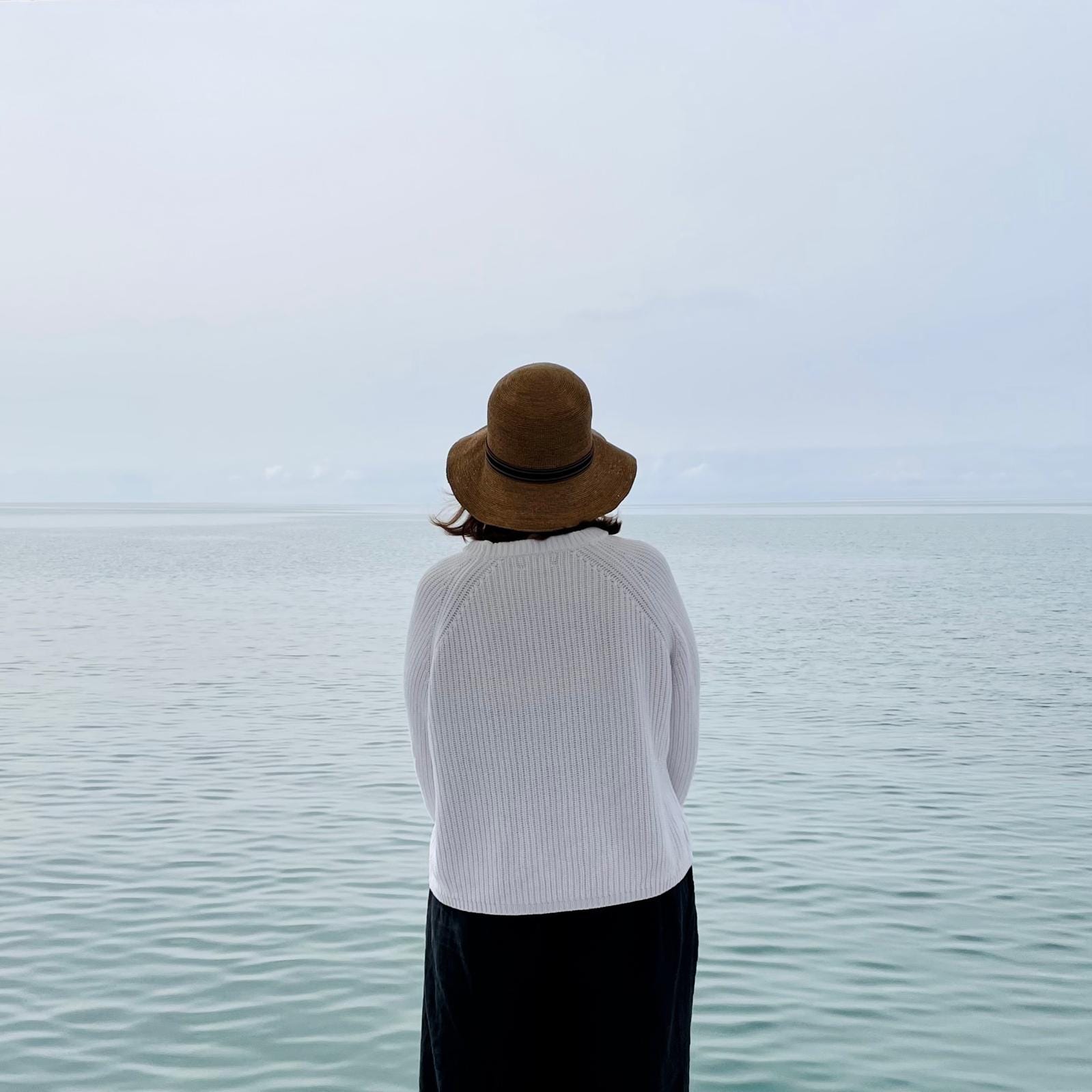
“Apparently, if you stare at the horizon line for long enough, it lowers your blood pressure,” I say.
Nora and Noah have climbed down the dock stairs and have discovered some sort of tiny lake shrimp invisible to the adult eye. They are enthralled.
The water sparkles. There are no boats. Every now and then, I detect a far-out splash from an Armenian lake salmon.
The next day, we drive to visit the petroglyphs, which are out in a huge open field in Cholpon-Ata.
“I know what a petroglyph is,” Nora tells me. “I saw one down by the beach. It was a rock with a Minion painted on it.”
I think, then, of our nature guide in Kazakhstan, who, when I asked if there were any petroglyphs in Charyn Canyon, said “Only modern ones,” and pointed to some graffiti.
Cholpon-Ata’s petroglyphs are ancient: dating from the 2nd millennium BC to the 4th century AD. On the rocks, you can spot images of horned goats, chariots, archers, camel riders, and snow leopards. There are also balbals, ancient Turkik statues honoring warriors and ancestors.
Everything’s just, like, out there. It costs 80 som (about 91 cents) to enter the “open air museum.” Some petroglyph rocks are marked with blue metal flags, but others we just stumble upon in our wanderings. No one but the moms are telling people not to touch the ancient artifacts.
“Please don’t put your kitty on the balbal,” I say.
“Please don’t walk on that rock, it might be a petroglyph,” says Sonja.
The adults are delighted. The weather is perfect. The little scrubby plants are blooming with yellow flowers. The horned goat art is really, really cool.
But the children are not happy. Nora has tripped over a rock and scraped her knee. Noah voices, again, that he would rather be at the pool.
The truth about parenting, especially on a trip (note, I did not call it “vacation”), is that the things that make adults happy are straight misery for the children, and vice versa. Adults want to sit. Adults want to nap. Adults want to stare at the lake in silence and read a book. Kids want to go to the resort playground where there are no benches. Kids want to cover their bodies in sand where there are no chairs.
Lunch in town, an adult win not only for sitting, but also for avoiding #SADCAF, turns out to be a surprise kid win due to the presence of a large orange patio cat. Noah and Nora feed him all the pepperoni off of the pizza and croon at him, disturbing the other patio diners.
Sonja and I try to keep them reigned in, but not really.
Nora also uses the lunch time to draw in her notebook.
“I’m going to draw all the best lake memories,” she says.
Noah in the Water Bee. Nora throwing a chicken nugget into the lake. A balbal version of her stuffed cat. Two stick figures looking for shrimp on the pier.
“Now can we go to the pool?” Noah asks.
“Now we can go to the pool,” say the adults.
Suited up, we arrive at the pool just as Bedazzled Pool Lady is closing up shop.
“Lunch break,” she says, pointing to a sign on the door that says the pool will be closed from 12:30 until 2PM. This was not on the map Tilek gave me. This was not in the plan.
Nora bursts into tears.
“But I want to go swimminnnnnnnnnnng,” she wails.
I become the worst version of myself.
“This is ridiculous,” I say. “We are having a TERRIBLE TIME.”
Bedazzled Pool Lady answers me in Russian. She doesn’t understand me, and I don’t understand her, and finally all I can do is gesture to Nora, who is still sobbing, with the universal mom communication of and what do you want me to do with this?
“Harasho, harasho,” she says. Fine, fine—and she ushers us into the pool and gives us our shower caps. She stays until Sonja and Noah arrive, and then locks us in.
“I CANNOT HANDLE ONE MORE CLOSED THING,” I say to Sonja.
“I am trying really hard to be cool,” she says, “but I realize that I am not, in any way, cool. I am not cool. I am too American.”
“I am too American,” I agree, “and I just want AMENITIES.”
It doesn’t matter how many years I have lived overseas. It doesn’t matter that I no longer feel like I understand America, like I belong in either in the political hellscape or the buffet of choices that is every capitalist, consumerist venue. The muchness of America chafes, but I’m not cut out for ease in any other culture, either. I still want extra information. I want my calendar set in advance. I want the spa to offer pedicures and the beachfront restaurant to have margaritas. I want things to be open when they say they’re going to be open. I want to get what I pay for.
I am ashamed and indignant all in the same breath. But I am not, and I never again will profess to be, cool.
After the kids are showered and we’ve succumbed to screen time, Alex knocks on my door and asks me to come out into the hallway.
“What is it?” I hiss, convinced something terrible has happened.
“It’s Shellington’s right foot,” he says, grinning, holding it out in his palm like the holy object it is.
“You’re kidding,” I say. “How???”
“Tilek from Reception,” Alex says.
“Tilek from Reception found Shellington’s right foot.”
In the face of all that is ridiculous, humans continue to be good.
On our final morning after breakfast (French fries, French toast with no syrup, more vodka for the man at the table nearby), we head down for one last look at the lake.
It has rained overnight, and the weather has turned. There’s wind. The lake is sloshing with waves. We can’t see to the bottom to spot chicken nuggets or anything else.
On the unsanctioned pier, some young Kyrgyz dudes are parkouring their way over the locked gate. No one is stopping them, and I hope they get away with everything they’re planning.
We snap a few pictures. We breathe the clean air.
On the count of three, all six of us scream, “GOODBYE ISSYK-KUL!” at the top of our voices, and the kids keep the noise going with various howls and whoops.
On the beach, a family tries to keep their blanket from blowing into the lake. A resort employee turns some kids on bikes away from the boardwalk, pointing to the “no bikes” sign.
“When can we come back here?” Nora asks.
“To this resort? Oh baby, we won’t be coming back here,” I say.
“But I loved this lake vacation. I loved the pool. I loved the lake. I loved feeding pepperoni to the cat. I want to come back!” she says.
I may not be cool, but the children are happy.
Soon, we will leave the edge of the map. We’ll head south to India, into another game entirely, where I’ll never get to wear a sweater in May, and where I will probably continue to be baffled by my own overinflated expectations, even if the people around me speak English.
Sonja, Alex, and Noah will leave Bishkek and return to the States for language training. We may never be in the same place again, much less pacing around together, at night, in the rain, looking for Shellington’s right foot. Everything is difficult and petty and heartbreaking and huge. I’m ready to go, but I’m not ready to leave.
Stay out of trouble, stay in touch,
Dot
Follow Along on Instagram

DISCLAIMER: The views expressed in this newsletter are my own, and do not necessarily reflect those of the US Department of State or the US Government.
So. good.
I mean, obviously not the vacation (although maybe). You had me at so many lines, but the one that will stay with me for a while is " I’m ready to go, but I’m not ready to leave."
Wow.
This was so unbelievably good. I completely relate to the misery of the experience and then realizing that somehow your child still had a blast.